
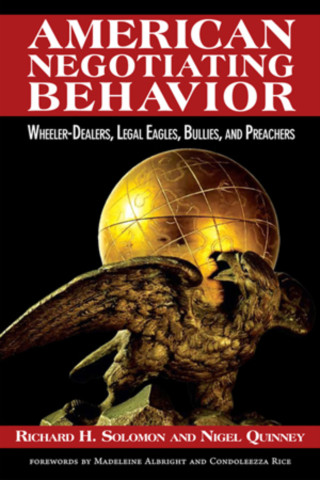
American Negotiating Behavior
Wheeler-Dealers, Legal Eagles, Bullies, and Preachers
April 2010
Informed by discussions and interviews with more than fifty seasoned foreign and American negotiators, this landmark study offers a rich and detailed portrait of the negotiating practices of American officials. Including contributions by eleven international experts, i assesses the multiple influences—cultural, institutional, historical, and political—that shape how American policymakers and diplomats approach negotiations with foreign counterparts and highlights behavioral patterns that transcend the actions of individual negotiators and administrations.
“A goldmine of useful information and ideas that can help make American negotiators--and their counterparts--more effective and the process of negotiations better understood."
George P. Shultz, Hoover Institution
“American Negotiating Behavior is a truly unique study of the American negotiator because it explores the foreign perception of American negotiators.”
Zbigniew Brzezinski, Center for Strategic and International Studies
"This book is a gold-mine for anyone interested in American negotiation styles and methods, analysed by two perceptive co-authors and eight experienced international practitioners of diplomacy. One of many merits of the book is that it sets out the parameters for a future diplomacy, adapted to a world where dialogue and negotiations hopefully will be the primary tools for solving conflicts and global problems."
Jan Eliasson, Former Minister for Foreign Affairs of Sweden and President of the United Nations General Assembly
“American Negotiating Behavior may well become the definitive primer on the art of effective cross-cultural negotiating. It should be an important part of the education of U.S. diplomat, as well as anyone engaged in international transactions.”
Henry A. Kissinger, U.S. Secretary of State 1973-1977
Richard H. Solomon
Richard H. Solomon was president of the United States Institute of Peace from 1993 to 2012 and oversaw its growth into a center of international conflict management analysis and applied programs.
Prior to this assignment, Solomon was assistant secretary of state for East Asian and Pacific affairs from 1989 to 1992. He negotiated the Cambodia peace treaty, the first United Nations “Permanent Five” peacemaking agreement; had a leading role in the dialogue on nuclear issues between the United States and South and North Korea; helped establish the Asia-Pacific Economic Cooperation initiative; and led U.S. negotiations with Japan, Mongolia, and Vietnam on important bilateral matters. In 1992-93, Solomon served as U.S. ambassador to the Philippines. He coordinated the closure of the U.S. naval bases and developed a new framework for bilateral and regional security cooperation.
Solomon previously served as director of policy planning at the Department of State and as a senior staff member of the National Security Council. In 1995, Solomon was awarded the State Department’s Foreign Affairs Award for Public Service, and he has received awards for policy initiatives from the governments of Korea and Thailand. In 2005, he received the American Political Science Association’s Hubert H. Humphrey career award for “notable public service by a political scientist.”
Solomon began his career as professor of political science at the University of Michigan, and also served as head of the Political Science Department at the RAND Corporation. Solomon holds a Ph.D. in political science, with a specialization in Chinese politics, from the Massachusetts Institute of Technology.
Nigel Quinney
Nigel Quinney is president of The Editorial Group and a consultant to European and American think tanks, academic institutions, and multinational corporations. He has more than twenty years' experience as an editor, writer, and researcher in the fields of international relations and conflict resolution.